
The Biggest IPO in History Just Happened
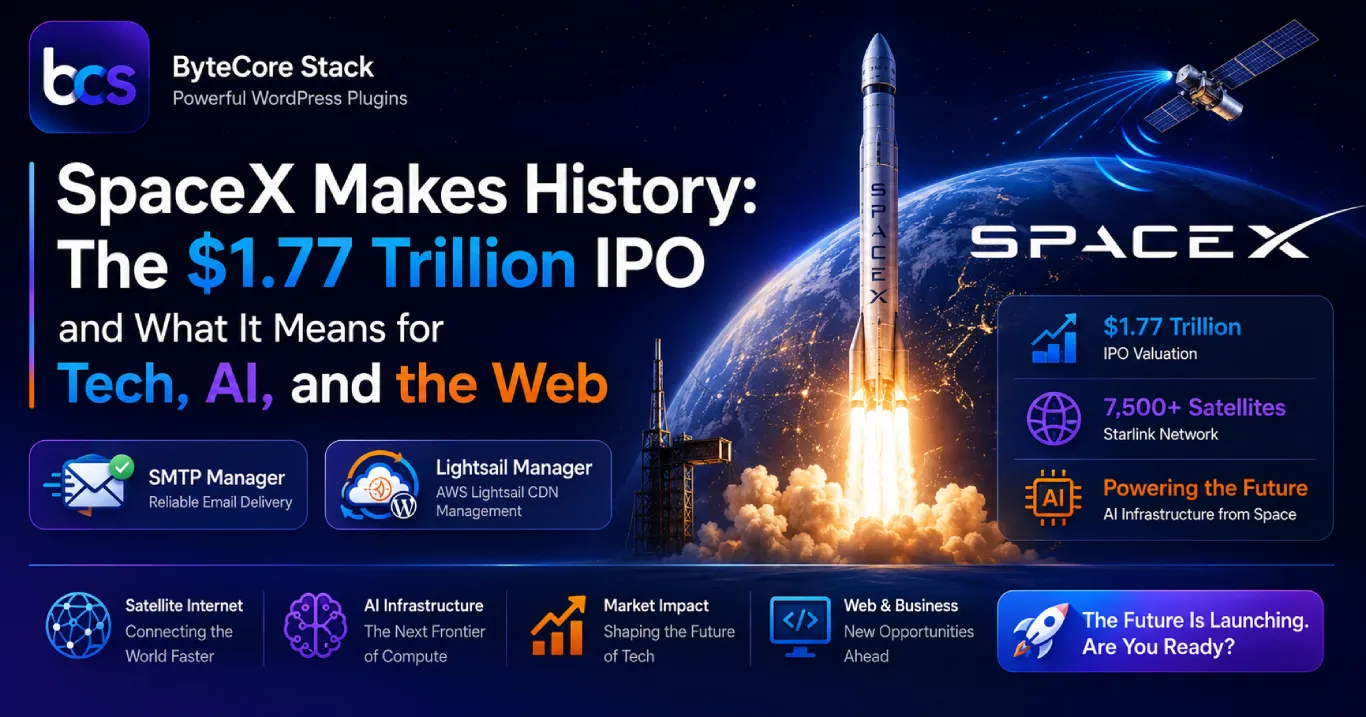
On June 12, 2026, Elon Musk’s SpaceX made history on the Nasdaq under the ticker SPCX. The company raised $75 billion by selling 555,555,555 shares at $135 each — the largest initial public offering ever recorded, surpassing Saudi Aramco’s $29 billion IPO in 2019 by a staggering margin. At its IPO price, SpaceX was valued at $1.77 trillion, instantly placing it among the ten most valuable publicly listed companies on Earth.
By the end of its first trading day, SPCX closed at $161 — a 19% jump — pushing SpaceX’s market cap above $2 trillion and making it worth more than Tesla, which traded at around $1.2 trillion at the time. This wasn’t just a Wall Street milestone. It was a signal that the next decade of technology — AI infrastructure, satellite internet, and space computing — is now being priced into public markets in a major way.
What SpaceX Actually Is in 2026
SpaceX is no longer just a rocket company. It’s best understood as three converging businesses:
- Starlink — The satellite internet division that accounts for roughly 58% of SpaceX’s total revenue. It’s the only profitable segment and the primary driver behind the valuation. With over 7,500 satellites in low Earth orbit, Starlink is the largest active satellite network ever deployed.
- Launch and aerospace — NASA contracts, commercial satellite launches, and Starship development. Revenue-generating but capital-intensive.
- Space-based AI infrastructure — This is the emerging layer. SpaceX plans to use IPO proceeds to fund space-based data centers, positioning itself as a potential backbone for AI compute that isn’t constrained by land, power grids, or government interference.
SpaceX’s 2025 revenue reached $18.67 billion, with projections of $22–24 billion for 2026. Analysts note a price-to-sales ratio of roughly 60 at the IPO price — among the richest valuations of any large-cap company, which means the market is pricing in significant future execution across all three of those segments simultaneously.
The Ripple Effects Across Tech and AI
The SpaceX IPO didn’t happen in isolation. It landed in the middle of a broader wave of AI infrastructure investment that’s reshaping the entire technology industry. Here’s what’s happening in the background:
AI Infrastructure Is Now the Real Race
The conversation in tech has shifted decisively from “which AI model is smartest” to “who controls the compute, power, and networking infrastructure that AI runs on.” SpaceX’s space-based data center ambitions are a direct play on this shift — if terrestrial data centers face energy constraints, land restrictions, and political backlash (Ohio recently suspended major tax incentives for data centers after community pushback), orbital compute becomes a strategic alternative.
Knock-On Effects for Competing Space Companies
SpaceX’s Nasdaq debut immediately pressured other space stocks. Firefly Aerospace dropped over 18%, while Rocket Lab, Redwire, and Intuitive Machines each fell at least 10%. Virgin Galactic plunged 34%. The market appears to be consolidating around SpaceX as the dominant public space infrastructure play, leaving smaller competitors with less room.
Alphabet as a Hidden Winner
Alphabet (Google’s parent company) holds a stake in SpaceX, making it one of the largest indirect beneficiaries of the IPO. This matters because Google is simultaneously investing heavily in AI search and infrastructure — a reminder that the biggest technology companies are increasingly interconnected through cross-holdings and shared infrastructure bets.
Tesla, xAI, and Merger Speculation
SpaceX’s amended IPO filing noted it may issue “significant equity” to fund future transactions. This sparked fresh speculation about a potential SpaceX-Tesla merger. Tesla had previously invested $2 billion in xAI before it was acquired by SpaceX, making Tesla a stakeholder in SpaceX. The web of Musk-connected companies is tightening in ways that public market investors are only beginning to price.
What Does This Mean for Business Owners and Web Developers?
If you run a business online — whether that’s a WordPress site, a Shopify store, or a custom web application — the SpaceX IPO and the AI infrastructure wave behind it have practical implications:
1. Satellite Internet Is Getting More Serious
Starlink’s growing subscriber base means reliable high-speed internet is increasingly accessible in rural and underserved areas. For businesses targeting customers outside metro areas, or for remote teams, this is a structural market expansion. It also means your website’s performance matters across a wider range of connection types — fast-loading, lightweight sites will reach more customers than ever.
2. AI-Powered Web Tools Are Accelerating
The capital flowing into AI infrastructure is compressing the timeline for AI tools becoming standard in web development and digital marketing. What required expensive enterprise contracts two years ago is now available as a plugin or API. On the WordPress side, tools like our MCP Manager plugin — which connects AI assistants directly to your WordPress site — are examples of this infrastructure becoming accessible at every level. Read more about how MCP bridges WordPress and AI assistants.
3. Website Reliability and Email Delivery Become More Critical
As AI search tools (like Google’s Gemini-integrated search) increasingly summarize businesses rather than linking to them, the technical quality of your site matters more, not less. A site that loads slowly, loses emails to spam, or breaks on mobile is losing business in ways that are harder to see but increasingly costly. That’s exactly why we built tools like SMTP Manager for reliable email delivery and Lightsail Manager for CDN performance — the boring infrastructure layer that most sites neglect until something breaks.
4. The Platform Choice Matters More Than Ever
With AI reshaping how customers discover businesses online, the platform your website runs on affects how well AI tools can read, index, and represent your business. WordPress, Shopify, and custom applications each have different strengths here — see our full breakdown in WordPress vs Shopify vs Magento vs Custom Development.
Is SPCX Worth Buying?
This isn’t investment advice — and the signals are genuinely mixed. The bull case is compelling: Starlink’s dominance in satellite internet, Starship’s cost-per-kilogram economics for orbital launches, and the space-based AI data center opportunity are all real. But a price-to-sales ratio of 60 at IPO — higher than the richest tech valuations seen during the 2021 bubble — assumes near-flawless execution across all three segments simultaneously. Near-term price projections from analysts suggest the stock may trade below the $135 IPO price through summer 2026 before finding its footing. Anyone considering participation should treat it as speculative and size accordingly. Consult a licensed financial advisor before making any investment decisions.
FAQ
When did SpaceX go public?
SpaceX began trading on the Nasdaq on June 12, 2026, under the ticker symbol SPCX, after confidentially filing with the SEC on April 1, 2026.
How much did SpaceX raise in its IPO?
SpaceX raised $75 billion by selling 555,555,555 shares at $135 each — the largest IPO fundraise in history, surpassing Saudi Aramco’s $29 billion in 2019.
What is SpaceX’s valuation after the IPO?
At the $135 IPO price, SpaceX was valued at $1.77 trillion. After closing at $161 on its first trading day, its market cap surpassed $2 trillion.
What is Starlink and why does it matter?
Starlink is SpaceX’s satellite internet division and the company’s only profitable segment, accounting for roughly 58% of total revenue. It operates over 7,500 satellites in low Earth orbit.
What does the SpaceX IPO mean for other space companies?
Competing space stocks dropped sharply after SpaceX’s debut, with Firefly Aerospace, Rocket Lab, Virgin Galactic, and others all falling significantly on the day.
Conclusion
The SpaceX IPO is more than a Wall Street event — it’s a signal that the infrastructure layer of AI and the internet is entering a new phase of capital investment and public accountability. Whether you’re tracking it as an investor, a developer, or a business owner, the broader shift it represents — toward AI-powered infrastructure, satellite connectivity, and orbital compute — is going to shape how the web works over the next decade.
At ByteCore Stack, we’re tracking these trends closely because they directly affect the tools and platforms we build on. Stay updated by reading our AI ROI trends post, and if you want your website ready for this next wave — whether it’s AI integration, performance, or platform migration — get in touch with our team.