

The Question Every Business Owner Eventually Asks
“Should we build this on WordPress, Shopify, Magento, or something custom?” It’s one of the most common questions we get from new clients, and the honest answer is: it depends on what you’re trying to do, how fast you need to move, and what your business looks like in three years — not just today.
Here’s how we actually walk clients through this decision.
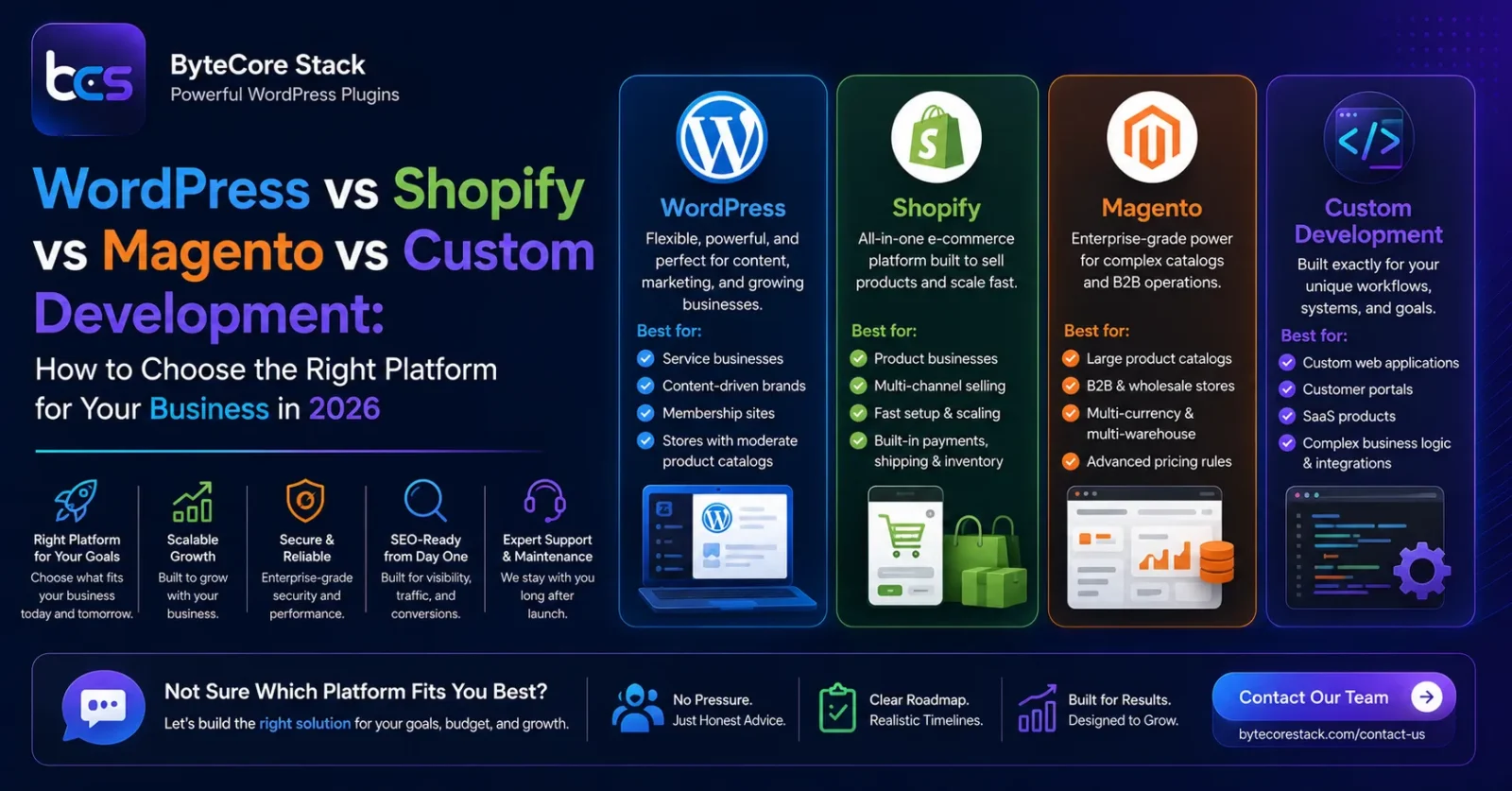
WordPress: The Default for Content, Marketing Sites, and Flexible Businesses
WordPress now powers a substantial share of all websites globally, and for good reason — it’s flexible enough to be a marketing site, a blog, a booking platform, a membership site, or a lightweight store (via WooCommerce), often all at once.
Best for: Service businesses, agencies, content-driven brands, and stores with moderate product catalogs that also need strong SEO and content marketing. We’ve built everything from AI-connected WordPress tooling to landing pages for luxury real estate projects on WordPress — it scales further than people expect.
Shopify: When Selling Products Is the Entire Business
Shopify is purpose-built for e-commerce. If your business is fundamentally a product catalog with checkout, Shopify removes a huge amount of complexity around payments, shipping, and inventory that you’d otherwise need to engineer on WordPress.
Best for: Pure product businesses, especially those planning to sell across multiple channels (Instagram, marketplaces) where Shopify’s ecosystem of integrations does the heavy lifting.
Magento (Adobe Commerce): For Complex, High-Volume Catalogs
Magento makes sense when a business has outgrown simpler platforms — multi-currency, multi-warehouse, B2B pricing tiers, or catalogs with tens of thousands of SKUs. It’s powerful, but it comes with real hosting and maintenance overhead, and usually needs a dedicated development team.
Best for: Established mid-to-large businesses with complex catalog or B2B requirements that smaller platforms genuinely can’t handle.
Custom Application Development: When the Product IS the Software
Sometimes the “website” isn’t really a website — it’s a customer portal, a booking system with specific business logic, an internal tool, or a SaaS product. In these cases, off-the-shelf platforms become a constraint rather than a help. Custom development gives you exactly the workflow your business needs, with no compromises around a CMS’s assumptions.
Looking for a WordPress Developer for Your Small Business in India?
If you’ve searched for a “WordPress developer for small business in India” or similar, here’s what that actually means in practice for most businesses we work with:
- WordPress developer for small business (India and remote): a fixed-scope build — usually a 5-10 page business site with contact forms, SEO basics, and a CMS your team can update without calling a developer for every text change.
- WooCommerce maintenance services: ongoing plugin/core updates, security monitoring, broken-checkout fixes, and performance tuning — billed monthly so a store doesn’t silently break between sales seasons. This pairs well with reliable email delivery, which is exactly what our SMTP Manager plugin and our SMTP plugin comparison guide cover for order confirmation emails.
- Small business website redesign: migrating an outdated site to a faster, mobile-friendly, SEO-structured WordPress build without losing existing search rankings.
- WordPress speed and CDN optimization: if your site is hosted on AWS, our Lightsail CDN management guide covers a quick win many small businesses are missing.
Our Approach
We don’t push every client toward the same platform — we’ve built and maintained projects across WordPress, custom PHP applications, and landing pages for sectors from hospitality to real estate to WiFi infrastructure. What we focus on across all of them:
- SEO-ready structure from day one (we’ve done full SEO metadata audits across hundreds of pages for clients)
- Lead capture that actually works — forms connected to CRMs like Glasshive and LeadSquared, not just a “thank you” page
- Reliable hosting, deployment pipelines, and ongoing maintenance so the site doesn’t quietly degrade over time — see our take on why technical foundations matter more in the AI era
Not Sure Which Path Fits Your Business?
If you’re planning a new website, an e-commerce store, or a custom application and aren’t sure where to start, that’s exactly the conversation worth having before any code gets written. Contact our team for a no-pressure look at your project — we’ll give you a straight answer on the right platform, realistic timelines, and what it’ll take to get found in search once it’s live.
You can also see the tools we build for our own WordPress projects on our plugins page, and learn more about our team on the About Us page.