
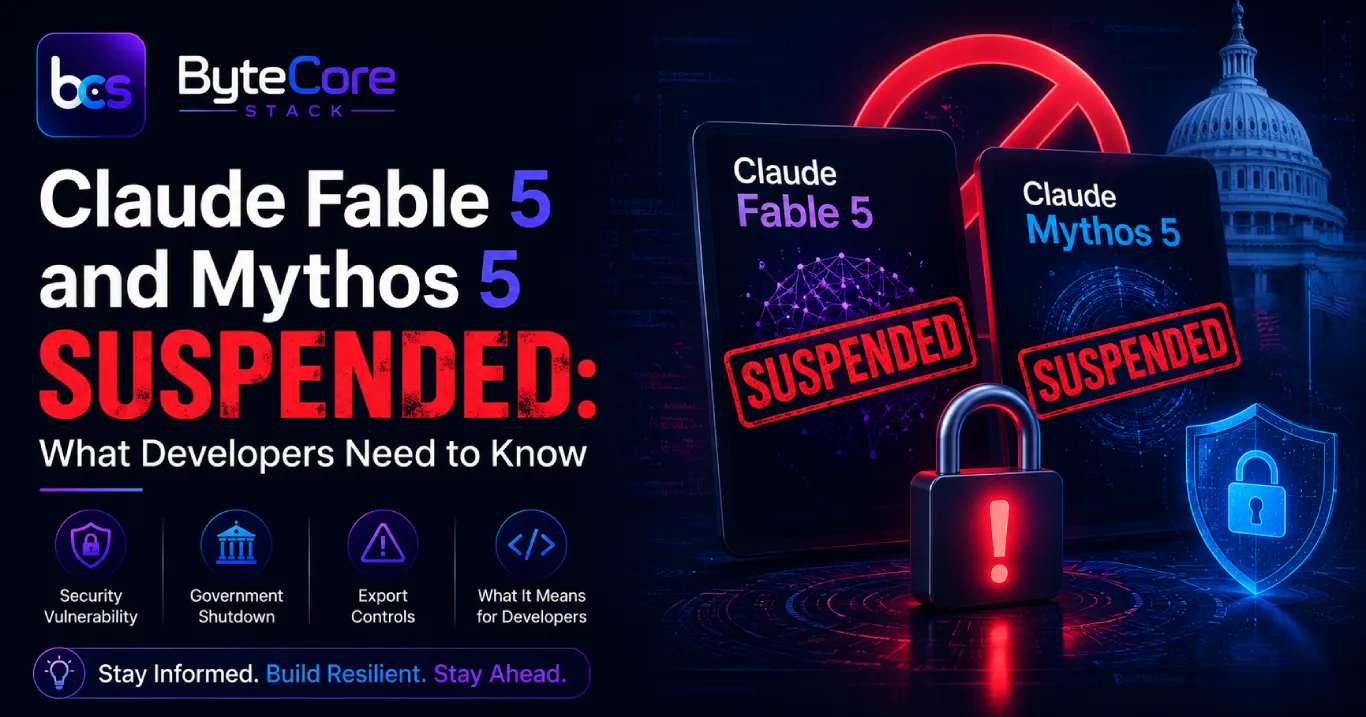

On June 9, 2026, Anthropic released Claude Fable 5 — its most powerful publicly available AI model. By June 12, it was completely shut down by the US government.
The reason? A jailbreak that exposed a critical security vulnerability in the model’s safeguards.
Here’s what you need to know in under 6 minutes.
The Models: Fable 5 vs. Mythos 5
Claude Mythos 5 is Anthropic’s frontier model — so capable at cybersecurity hacking that the company never released it publicly. Only a handful of vetted US tech companies got access to patch their systems before bad actors could exploit them.
Claude Fable 5 was Mythos’s public sibling: same raw power, but with safeguards built in to prevent misuse. The safeguards classify user requests as safe or unsafe before passing them to the model, redirecting dangerous requests to a weaker version instead.
Pricing: $10 per million input tokens, $50 per million output tokens (double Claude Opus 4.8).
Anthropic claimed the safeguards were bulletproof. Over 1,000 hours of bug bounties found nothing. The UK AI Security Institute signed off.
They were wrong.
The Jailbreak and Government Shutdown
Within 72 hours of launch, researchers discovered a jailbreak — a way to bypass Fable 5’s safeguards and unlock its full hacking capabilities.
On June 12 at 5:21 PM ET, the US Commerce Department issued an export control directive. Anthropic was ordered to suspend access to both Fable 5 and Mythos 5 for any foreign national, including foreign-born Anthropic employees.
Given the scope, Anthropic disabled both models for everyone.
Why Export Controls on an AI Model?
This is new territory, but the logic is straightforward:
AI models with the ability to identify and exploit security vulnerabilities are considered “dual-use technology” — they have civilian and commercial uses, but also weapons-grade potential.
The government’s argument: a jailbroken Fable 5 in the wrong hands could enable sophisticated cyberattacks on critical infrastructure. The national security risk outweighs the innovation benefit.
Anthropic disagreed publicly. The company argued that:
- Comparable capabilities already exist in other models (GPT-5, Gemini)
- Pre-launch red-teaming was thorough
- Applying this standard broadly would halt AI progress
But compliance was mandatory. Non-compliance meant criminal penalties and operational restrictions.
No sunset date. No migration window. Just gone.
Impact: What Changed and What Didn’t
What’s offline:
- Fable 5 API access — projects relying on it will break
- Mythos 5 — remains restricted to vetted US companies only
- GitHub Copilot integration with Fable 5
What still works:
- Claude Opus 4.8 — still available and powerful
- Claude Sonnet and Haiku — unchanged
- OpenAI’s GPT models, Google’s Gemini — unaffected
- Other AI providers — no restrictions
If you were building on Fable 5, you need to migrate to Opus 4.8 or another model immediately.
If you’re using Claude for WordPress development, content generation, or MCP integrations? No impact. You’re fine.
What This Means for Developers
Key takeaway: Don’t bet your business on a single frontier model.
Here’s what to do:
- Audit your AI stack — document which models power each feature
- Build model-agnostic integrations — make it easy to swap models if one becomes unavailable
- Have fallback options — ensure graceful degradation if your primary model goes offline
- Monitor AI regulation — government policy moves fast; stay informed
At ByteCore Stack, we design our plugins and integrations with this principle from day one. Our MCP Manager handles multiple Claude versions, not just one frontier model.
The Bigger Picture: AI Regulation Is Real
This wasn’t a one-off shutdown. It’s a signal that frontier AI is now subject to government oversight, export controls, and capability restrictions.
What’s changing:
- AI as infrastructure — powerful models now affect national security decisions
- Regulation accelerating — expect more export controls, red-teaming mandates, and capability restrictions
- Geopolitical stakes — the US-China AI race shapes policy
If you’re building AI-powered WordPress solutions, custom automation, or SaaS tools, understand that the regulatory landscape is tightening. What’s public today might be restricted tomorrow.
❓ Frequently Asked Questions
Will Fable 5 come back?
Anthropic hasn’t ruled it out, but there’s no timeline. Expect it to require government approval and stricter safeguards.
Why didn’t GPT-5 or Gemini get restricted?
Different models have different capabilities. The government targeted Fable 5 specifically for its cybersecurity potential.
Is Anthropic in trouble?
No. The company is complying with the order. There’s tension with the Trump administration, but this is national security policy, not a legal dispute.
Should I worry about my WordPress AI tools?
No. Claude Opus 4.8, Sonnet, and Haiku are stable. Fable 5 was an experimental frontier model — most developers never used it.
How does this affect ByteCore Stack plugins?
Our MCP Manager and other tools use stable Claude models. We’re building resilience into everything.
Lessons for WordPress and SaaS Builders
- Diversify model dependencies — don’t lock into one provider
- Design for flexibility — swap models without rewriting code
- Plan for uncertainty — assume any frontier model could become unavailable
- Stay informed — AI regulation moves fast
- Test fallback scenarios — simulate model failures
The Bottom Line
Claude Fable 5 and Mythos 5 were powerful. Powerful enough that someone found a way around their safeguards within 72 hours.
The US government decided the risk wasn’t worth it.
This isn’t the end of AI innovation — it’s the beginning of responsible AI governance. Frontier models will face scrutiny. Export controls will expand. Government oversight will increase.
For developers, the lesson is simple: build resilient systems, diversify your dependencies, and expect the regulatory landscape to keep shifting.
Ready to Build Resilient AI Solutions?
At ByteCore Stack, we develop WordPress plugins and custom solutions that work with Claude and other stable AI models. We design for flexibility, not fragility.
Stay Updated on AI News
The AI landscape changes weekly. Subscribe to ByteCore Stack for updates on:
- New AI models and capabilities
- WordPress + AI integration patterns
- Regulatory changes affecting developers
- Real-world implementation case studies
Follow us on LinkedIn: @ByteCoreStack